Request for callback
By


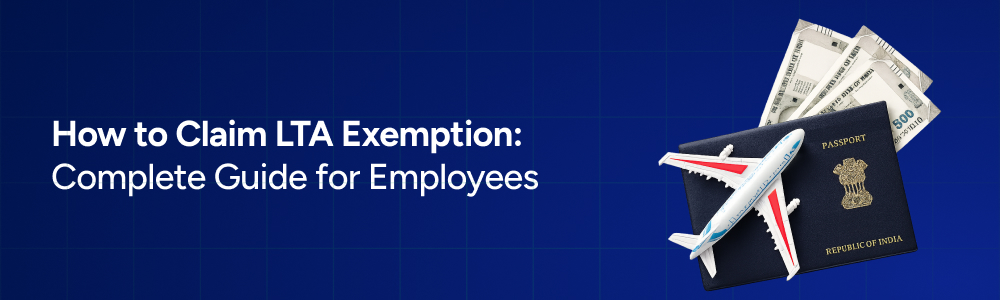
Leave Travel Allowance shows up in your salary slip every month. That ₹2,000 or ₹3,000 sitting there. Most people know it exists. Fewer actually use it.
Here's the thing: LTA is taxable unless you claim the exemption. To claim it, you need to actually travel, domestic travel within India, following specific rules, with proper documentation.
Get it right, save tax on a significant amount. Get it wrong, entire LTA becomes taxable.
The rules aren't complicated, but they're specific. Let's walk through exactly how to claim LTA exemption.
What LTA Actually Is
Leave Travel Allowance is a component of salary meant to help employees with travel expenses during leave. Employers include it in salary structure, and it shows up monthly in your payslip.
But here's the catch: just receiving LTA doesn't make it tax-exempt. You need to actually travel to claim the exemption.
Without travel: LTA is fully taxable as salary.
With eligible travel: The amount you spent on travel (subject to limits) becomes tax-exempt. The exemption falls under Section 10(5) of the Income Tax Act.
Block Year System: Two Journeys in Four Years
You can't claim LTA exemption every time you travel. It's limited to two journeys within a block of four calendar years.
Current block: 2022-2025. Previous blocks: 2018-2021, 2014-2017.
Within 2022-2025, you can claim exemption for two separate journeys. Could be 2022 and 2024. Could be both in 2023.
Unused journeys: One unused journey from 2018-2021 can be carried forward to 2022-2025 (COVID dispensation). Maximum possible in current block: three journeys (two from current block plus one carryforward).
What Travel Qualifies
Not all travel qualifies for LTA exemption. Specific conditions apply:
1. Travel must be within India
Domestic travel only. Trip to Thailand? Europe? Dubai? Not covered. The exemption is specifically for travel within India.
2. Must be for self or family
Family includes:
- Spouse
- Children (maximum two children born after October 1, 1998; all children if born before that date)
- Parents
- Brothers and sisters (dependent on you)
3. Must actually undertake the journey
Can't just submit fake bills. You need to have actually traveled. Boarding passes, tickets, proof of journey, all required.
4. Leave is not mandatory
Despite the name "Leave Travel Allowance," you don't actually need to be on leave. You can claim LTA for travel during weekends, public holidays, or even while working from another location.
Exemption Limits: Not the Full Amount
Here's where people get confused. The exemption isn't unlimited. It's the lower of:
1. Actual LTA received from employer
If your employer gives you ₹50,000 as LTA for the year, that's your ceiling.
2. Actual travel expenditure
If you spent ₹40,000 on travel but received ₹50,000 LTA, exemption is only ₹40,000.
3. Deemed fare for the mode of travel
This is the tricky part. Even if you spent ₹60,000 on business class air tickets, the exemption might be limited to economy fare.
The deemed fare rules:

Calculation Examples
Example 1: Air travel, straightforward
LTA received: ₹60,000 annually Traveled: Bangalore to Delhi return Actual flight cost: ₹12,000 (economy) Shortest route economy fare: ₹10,000
Exemption: ₹10,000 (shortest route economy fare, which is less than actual spent and less than LTA received)
Taxable LTA: ₹60,000 - ₹10,000 = ₹50,000
Example 2: Multiple stops
LTA received: ₹80,000 Journey: Mumbai → Goa → Kerala → Mumbai Actual cost: ₹25,000
For multiple destinations, exemption covers fare for the entire journey, provided the family travels together and it's part of one continuous trip.
Shortest route would be Mumbai-Goa, Goa-Kerala, Kerala-Mumbai. Calculate economy/AC First Class fare for this route.
If shortest route fare comes to ₹20,000, exemption is ₹20,000.
Example 3: Different modes for family members
You flew economy (₹8,000), spouse traveled by train AC First (₹3,000), one child by train (₹2,000).
Total actual spent: ₹13,000 LTA received: ₹40,000
Exemption for air: Economy fare shortest route Exemption for rail: AC First Class fare shortest route
Both qualify. Total exemption: ₹13,000 (actual spent, which is less than deemed fare and less than LTA)
What Expenses Are Covered
LTA exemption covers only travel fare, getting from one place to another.
Covered: Flight tickets, train tickets, bus tickets (limited to AC First Class rail equivalent)
NOT covered: Hotel stays, food, local transport at destination, sightseeing, any expenses other than journey tickets If employer reimburses these, they're taxable. Only journey fare qualifies.
Documentation Required
To claim LTA exemption, you need solid documentation. During scrutiny, these documents prove your claim. Essential documents:
- Travel tickets/boarding passes: Original or copies showing:
- Journey dates
- Passenger names
- Origin and destination
- Fare paid
2. Proof of payment: If paid by card/online, transaction proof. If cash, receipts.
3. LTA claim form: Employer's form declaring:
- Journey details
- Family members who traveled
- Amount claimed
- Confirmation that travel was undertaken
4. Supporting proof for family: If claiming for spouse/children/parents, you might need:
- Marriage certificate (for spouse)
- Birth certificates (for children)
- Relationship proof (for parents)
5. Declaration: Self-declaration that journey was for personal purposes and within the block period.
How to Actually Claim
Step 1: Check your LTA entitlement in appointment letter or payslip.
Step 2: Plan domestic travel within your available block journeys.
Step 3: Keep all bills and tickets from booking to completion.
Step 4: Submit claim to employer with LTA form and documents (within 60-90 days of journey).
Step 5: Employer verifies, calculates exempt amount, adjusts TDS.
Step 6: Form 16 shows total LTA, exempted amount, and net taxable LTA.
Step 7: Verify in ITR filing (usually auto-populated from Form 16).
Common Mistakes to Avoid
1. Claiming international travel: Singapore trip doesn't qualify. Domestic only.
2. Claiming accommodation/food: Only travel fare is exempt. Hotel bills don't count.
3. Business class tickets: Flew business for ₹50,000? Exemption limited to economy fare, maybe ₹15,000.
4. Claiming without travel: Fake bills = fraud. Need actual boarding passes.
5. Not tracking blocks: Two journeys per block. Three attempts in one block won't work (unless carryforward).
6. Wrong family members: Cousin's travel doesn't qualify unless dependent and provable.
New Tax Regime Impact
LTA exemption is available ONLY under the old tax regime. New tax regime (lower rates, no deductions)? Entire LTA becomes taxable. For people who regularly travel domestically and claim LTA, old regime might work better. Calculate both scenarios before deciding.
LTA vs Actual Reimbursement
Some employers offer two options:
LTA: Fixed amount monthly, claim exemption when you travel. Taxable if you don't travel.
Travel reimbursement: No fixed amount, claim after travel with bills. Spend first, claim later.
From tax perspective, both fall under Section 10(5). Key difference is cash flow and company policy.
What Happens If You Don't Travel
LTA in your salary but didn't travel in a block year? It's fully taxable like regular salary. You can't carry forward unused LTA money to the next block. Each block is independent. The one-time carryforward from 2018-2021 to 2022-2025 was a COVID-exception.
Conclusion
LTA exemption requires actual domestic travel with proper documentation. Remember: two journeys per four-year block (2022-2025 currently).
Exemption covers only travel fare, limited to shortest route economy/AC First Class fare.
Keep boarding passes, tickets, and payment proof for claims and potential IT scrutiny years later.
New tax regime doesn't allow LTA exemption. Factor this into regime choice. Submit claims promptly after travel. Don't wait till year-end. Don't game the system with fake bills. Documentation trail is extensive and getting caught means penalties. Used properly, LTA saves several thousand rupees in tax annually. Follow the rules, travel within India, maintain documentation.
Book a Free Tax assessment call with us today!
Frequently Asked Questions
Q1: Received ₹30,000 LTA annually. Traveled in 2023 (₹15,000 spent). Can I claim again in 2024 for the remaining ₹15,000 from 2023?
No. Each journey's exemption is calculated independently. The 2023 journey gave you ₹15,000 exemption. That's done. If you travel again in 2024 (your second journey in the 2022-2025 block), the exemption will be based on 2024's actual travel cost and the LTA received in 2024, not leftover amounts from 2023. LTA exemption doesn't accumulate or roll over from year to year within a block. Each journey is evaluated separately based on actual expenditure, deemed fare limits, and LTA received for that specific period.
Q2: Traveled from Chennai to Guwahati via Delhi (with stopover). The direct Chennai-Guwahati flight was shorter and cheaper. Which route is considered for exemption?
Shortest route means the most direct route between origin and final destination. If Chennai-Guwahati direct is the shortest route, that's what matters for calculating deemed fare, even if you actually traveled via Delhi. The exemption is limited to economy fare for Chennai-Guwahati direct route. If you took a longer route with stopover for personal convenience, the exemption doesn't increase. However, if the stopover was to visit another place as part of the same trip and family traveled together, you might argue it's one continuous journey, but the deemed fare calculation still uses shortest routes between each segment.
Q3: Employer doesn't offer LTA in salary structure. Can I still claim exemption if I travel domestically?
No. LTA exemption under Section 10(5) applies only if your employer actually pays you LTA as part of your salary structure. If LTA is not a component of your salary (not shown in offer letter, payslip, or Form 16), you cannot claim this exemption even if you travel. The exemption requires actual receipt of LTA from employer. If your employer doesn't offer LTA, you could request them to restructure your salary to include it (keeping CTC same but changing components), but this is at their discretion and typically happens during appraisal or job change.
Q4: Traveled with spouse and two children in 2023. For one child (born in 2000), can I claim LTA exemption?
Yes, for children born before October 1, 1998, there's no limit—all children can be claimed. For children born on or after October 1, 1998, maximum two children can be claimed. Your child born in 2000 falls under the "after October 1998" category, so you can claim for maximum two children. If you have three children all born after 1998, you choose which two to claim in your LTA declaration. Both the child limit and the date cutoff matter. Make sure the children whose travel you're claiming are mentioned in your LTA claim form and you have their boarding passes/tickets as proof.
Q5: Claimed LTA in 2023, employer adjusted TDS accordingly. Now in 2024, IT department is asking for proof during scrutiny. Lost the boarding passes. What should I do?
This is problematic. Boarding passes are primary proof of travel. Without them, defending your LTA claim is difficult. Try these steps:
(1) Contact some airline as they maintain travel history and can provide a travel certificate or reprint of boarding pass if you provide PNR, booking reference, and identification.
(2) Provide supporting evidence, credit card statement showing flight booking payment, hotel bookings at destination showing you were there on those dates, any photographs with date stamps from the trip.
(3) Bank statement showing withdrawal/expenses at the destination. While these aren't substitutes for boarding passes, they corroborate that travel happened. Submit whatever you can with a written explanation. The AO may accept it or may disallow the claim and add that LTA to taxable income for that year. Lesson: Always maintain copies of boarding passes for at least 7 years. Digital copies work, just make sure they're safely stored.
Author
|

Prosperr is on a mission to simplify personal finance and taxation for every Indian. From smart tax-saving strategies to in-depth guides on income, investments, and benefits, our content is crafted to empower individuals with clarity and confidence in their financial journey
.jpg)