Request for callback
By


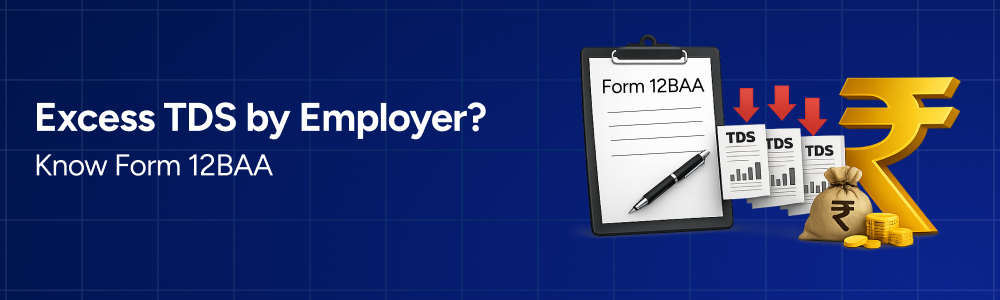
Picture this. March rolls around. You get your salary slip. The TDS deducted that month looks enormous, far more than you were expecting. You scratch your head, maybe fire off a message to your HR team, and they say something along the lines of: "We've computed it based on your salary. Everything is as per the system."
System. Right.
What the system doesn't know what it can't know unless you tell it is that your housing loan is generating a loss under house property that should be reducing your taxable income. Or that your bank already deducted TDS on a fixed deposit. Or that you've been paying TCS on remittances abroad. None of that is visible to your employer unless you make it visible.
That's what Form 12BAA is for. And most salaried employees in India have never heard of it.
Why This Even Exists — The Problem It's Solving
Every employer who pays salary is legally required, under Section 192 of the Income Tax Act, to deduct tax at source. TDS on salary. That's been the rule for decades and nobody disputes it.
The practical problem is this: your employer sees only one slice of your financial life your salary. But your actual tax liability for the year depends on your total income from all sources. Interest from fixed deposits. Rent from a property you own. Capital gains from mutual funds you redeemed. Losses from a house property you've taken a loan on.
Your employer, sitting with just your salary data, has no way to account for any of that. So they don't. They compute TDS as if your only income is what they pay you.
The result? Some employees get over-taxed through TDS and then spend the next several months after filing waiting for a refund that ties up money they could have used all year. Others, who have significant income from other sources, get under-taxed and face a scramble to pay the shortfall when they file.
Form 12BAA was introduced to bridge exactly this gap. It creates a formal, legally recognized channel through which you and the employee can share the full picture with your employer, so their TDS calculation actually reflects your real tax situation.
What You Can Report in This Form
Three categories of information go into Form 12BAA.
The first is income from sources other than salary. If you're earning interest on fixed deposits, receiving rent from a property you own, or have any other taxable income during the year, this is where you declare it. Your employer factors this additional income into the TDS calculation, adjusting the deduction upward if needed. Without this disclosure, that income sits invisible to the employer, and you end up paying the tax on it yourself at return filing time, sometimes with interest under Section 234B or 234C if you've underpaid through the year.
The second is TDS and TCS already deducted or collected from you elsewhere. Your bank deducts TDS on FD interest. A seller you paid collected TCS on a foreign remittance. These are real tax outflows money that's already left your pocket toward your tax liability. If your employer doesn't know about them, they'll deduct TDS without adjusting for what you've already paid. You'll end up with a refund situation rather than a clean year-end. Form 12BAA lets you report all of this upfront.
The third is loss from house property. This one is significant for a large number of salaried employees and yet it's widely underused. If you've taken out a home loan and the interest you're paying on it exceeds the rent you receive from the property or if you occupy the property yourself and have no rental income you have a loss under the heading "income from house property." That loss, up to ₹2 lakh per year under the current provisions, can be set off against your salary income. Your employer can factor this in and reduce the TDS accordingly. But only if you tell them through Form 12BAA. Leave it unreported, and the deduction is completely lost from the TDS calculation; you'd have to claim it at the return filing instead, which means waiting for a refund.
The Legal Backing — Section 192 and What It Says
Section 192 of the Income Tax Act is the provision that governs TDS on salary. It doesn't just say "deduct tax" it also says that the person making the salary payment must take into account any income or deductions reported by the employee when computing the tax to deduct.
Form 12BAA is the prescribed mechanism through which that reporting happens. Once you submit it, your employer is legally bound to incorporate that information into the TDS calculation. It's not a favour they're doing you. It's what the law requires them to do once you've provided the form.
This matters because it means there's no room for an employer to say "we don't have a process for this" or "our payroll system doesn't support it." The obligation is on them. The form exists. You submit it. They use it.
Now, the employer isn't obligated to independently verify everything you've declared. The responsibility for accuracy sits with you, the employee. If you report a house property loss that doesn't actually exist, or overstate TDS credits you haven't actually received, that's your problem to sort out come assessment time. The form is a self-declaration. Submit it honestly.
Who Benefits Most From This — and It's Not Who You'd Think
The obvious beneficiaries are people with home loans. If you're paying ₹4–5 lakh a year in home loan interest on a self-occupied property, you have a loss of ₹2 lakh (the cap on set-off against salary) sitting unused unless you report it. That ₹2 lakh reduces your taxable income. At a 30% tax slab, that's ₹60,000 less in tax. Per year. Your employer can adjust TDS for this throughout the year if you submit Form 12BAA early in the financial year April, ideally rather than letting them deduct excess tax all year and claiming it back as a refund in September.
The second group is people with significant non-salary income. Say you're a senior professional earning ₹30 lakh in salary and another ₹5 lakh in consulting fees outside your employment. Your employer knows about the ₹30 lakh. They don't know about the ₹5 lakh. If you disclose it via Form 12BAA, your employer adjusts TDS upward to account for the higher total income. You avoid the situation where you owe a large chunk of tax at return time which can trigger interest under Section 234B if advance tax wasn't paid.
The third group, often overlooked, is anyone who's had TCS collected at source during the year. In recent years, TCS has expanded significantly on overseas tour packages, on foreign remittances above ₹7 lakh under the Liberalized Remittance Scheme, on purchase of luxury goods, on certain vehicle purchases. These TCS amounts pile up. If you don't report them to your employer, they sit unclaimed until return filing, tying up your money.
How to Actually Submit It — The Practical Side
Form 12BAA is a self-declaration. You fill it out, sign it, and submit it to your employer. There's no portal submission involved. No online government filing. It goes directly to your HR or payroll team.
The ideal time to submit is at the start of the financial year April. This gives your employer the maximum number of months to spread the adjusted TDS across your remaining salary payments. The later in the year you submit, the more compressed the adjustment becomes. If you submit it in January for a financial year ending March, the employer has to cram three months of corrections into what's left leading to sharp spikes in that period's TDS deductions that can feel jarring.
You can also revise and resubmit the form during the year if your circumstances change. Say you sold a property in October and now have a capital gain you hadn't anticipated. You can update your declaration so your employer can factor that into the remaining months' TDS.
One thing to be clear about: submitting Form 12BAA doesn't replace filing your ITR. The annual return is still your obligation regardless. What the form does is make the TDS during the year more accurate so that your return filing becomes cleaner less tax owed at the end, fewer or no refunds to wait for, and no interest liability from underpayment.
What Happens If You Don't Submit It
Nothing dramatic, immediately. Your employer continues deducting TDS based on salary alone. That's legal. That's what they're supposed to do when they don't have additional information from you.
But here's what plays out over the years.
If you have a house property loss, you miss the TDS reduction you were entitled to. You've effectively given the government an interest-free loan for the year. You'll get it back as a refund, but refunds in India don't come with compensation for the time value of money you've lost.
If you have significant other income that wasn't accounted for, you've underpaid through TDS. If the gap is large enough, you could be liable to pay advance tax in the prescribed installments June 15, September 15, December 15, March 15. Miss those, and Section 234B and 234C interest kicks in. A form that took twenty minutes to fill out would have avoided all of it.
And if you've paid TCS during the year that your employer didn't know about, those credits remain stuck until you file your return and claim them. A refund follows sometimes months later, sometimes longer depending on how busy the processing queues are.
None of this is catastrophic. It's just inefficient. It's your money, circling around a system unnecessarily, when a straightforward disclosure at the start of the year could have kept it in your hands all along.
The Larger Point About Transparency in Tax Compliance
I've spent three decades watching how the relationship between taxpayers and the tax system actually works in practice not in theory, not in the manuals, but in real life.
What I've seen consistently is that the problems people face almost never come from the rules themselves. The rules, by and large, are workable. The problems come from not knowing the rules exist, or from assuming someone else, the employer, the accountant, the payroll system has taken care of something that only you can actually initiate.
Form 12BAA is a clear example. The provision exists. The legal backing is solid. The benefit is real and quantifiable. And yet a large portion of the salaried workforce in India either doesn't know about it or, knowing about it vaguely, hasn't bothered because it seems complicated.
It isn't complicated. It's a declaration. You list your other income, your TDS and TCS credits, and your house property loss. You hand it to HR. They update the payroll. Your TDS for the year becomes accurate. The year-end is cleaner.
That's the whole thing.
Before You Put This Off Until December
The most common mistake with Form 12BAA isn't getting the numbers wrong. It's timing.
People read about it, make a mental note, and tell themselves they'll sort it out. Then April becomes June, June becomes September, and by December they're filing it at the worst possible time when the employer has to compress a year's worth of adjustments into a handful of pay cycles.
April is the right month. The first or second week. Before payroll for the new financial year is processed. Submit the form with your estimated figures for the year. You can always revise later if something changes: a property sale, a new FD, an unexpected gain. Revision is allowed and straightforward.
Your employer's HR or payroll team will know what to do with Form 12BAA. If they seem uncertain, point them to Rule 26B of the Income Tax Rules, which prescribes the form and sets out the obligation on the employer to use it.
The form takes perhaps half an hour to fill out, once you have your figures ready. What it potentially saves you in excess TDS, in advance tax interest, in refund waiting time is considerably more than half an hour's worth.
Prosperr.io helps salaried individuals and others manage their income tax accurately and without the usual stress. Book a free tax assessment call here.
Disclaimer: This article is based on the author's personal understanding of the Income Tax Act, 1961 and relevant rules. It is intended for general informational purposes only and does not constitute professional legal or tax advice. Please consult a qualified tax practitioner for guidance specific to your situation.
Author
|

Prosperr is on a mission to simplify personal finance and taxation for every Indian. From smart tax-saving strategies to in-depth guides on income, investments, and benefits, our content is crafted to empower individuals with clarity and confidence in their financial journey