Request for callback
By


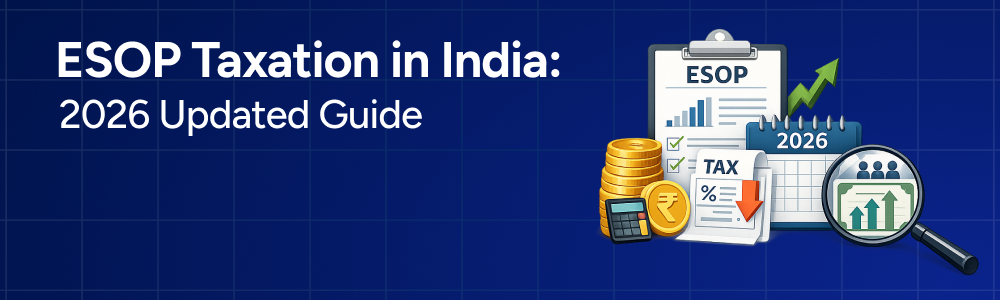
In India, Employee Stock Option Plans (ESOPs) are one of the most prevalent means of creating wealth for salaried professionals, especially in the startup and high-growth company space. While ESOPs provide the ability to significantly increase one’s earnings over time, most employees fail to account for the potential tax consequences associated with them.
Unlike other salary components, ESOPs are taxed at two separate points: Trailing the exercise of the option granted to the employee, and at the time of sale of the actual shares granted. Consequently, because of the typical complexities with taxation on "perks" and capital gain taxation for employees, employees can misunderstand how to calculate the full tax effect of ESOPs and/or determine their actual earnings relating to them.
Under the Income-tax Act, taxed as a taxable perquisite, the value of all shares allotted at a discount at the time of exercise of the option is treated under the category "Income from Salaries," while at the time of sale of the aforementioned shares, it is treated under the category "Capital Gains." Therefore, it is imperative for proper tax planning and liquidity management/a plan, to understand how these 2 Taxation Events work.
In this guide, we will discuss ESOP taxation in India for the fiscal year 2025-26, including (1) fair market value (FMV) calculations used to calculate ESOP taxes, (2) Perquisite Valuation of the shares granted, (3) capital gains treatment, and (4) ways to legally document potential income and expenses associated with ESOPs.
What Are ESOPs?
The Employee Stock Ownership Plan is a compensation plan that provides the employee with the ability to purchase a share of the corporation at a preestablished price, after a specified period of time. In order to have a good understanding of the taxes associated with your ESOP, you must have a grasp of 4 basic stages of the ESOP.
1️. Grant Date
This is the date on which the company offers the stock options to the employee. At this stage, no shares are transferred, and there is no tax implication.
2️. Vesting Date
Vesting refers to the date on which the employee earns the right to exercise the granted options. Vesting may happen gradually over time (for example, 25% each year for four years). Again, no tax is payable at the time of vesting.
3️. Exercise Date
This is when the employee actually purchases the shares by paying the exercise price. This is the first taxable event under Indian tax laws.
4️. Sale Date
This is when the employee sells the shares in the market. This triggers the second taxable event under capital gains provisions.
When Are ESOPs Taxed in India?
One of the most common misconceptions about ESOPs is that they are taxed when they are granted or vested. Under Indian tax laws, that is not the case. ESOPs are taxed at two specific stages, and only at those stages:
1️. Tax at the Time of Exercise (Perquisite Tax)
When you exercise your stock options and purchase the shares, the difference between:
“Fair Market Value (FMV) on the exercise date – Exercise price paid by you” is treated as a taxable perquisite.
2️. Tax at the Time of Sale (Capital Gains Tax)
When you later sell the shares, any difference between “Sale price – FMV considered at the time of exercise” is taxed as capital gains.
Tax at the Time of Exercise: Perquisite Valuation Explained
When you exercise your ESOPs, you are buying your company’s shares at a pre-decided price (called the exercise price). If, on that day, the share’s market value (Fair Market Value or FMV) is higher than what you are paying, the difference is treated as a benefit given by your employer. For example, if you buy a share for ₹50 and its market value is ₹105, the ₹55 difference is considered a perquisite. Since this benefit arises from your employment, it is added to your salary income and taxed according to your income tax slab in the year of exercise, even if you do not sell the shares at that time.
How Is the Perquisite Value Calculated?
The formula is straightforward: Perquisite Value = FMV on Exercise Date – Exercise Price Paid
If multiple shares are allotted: Perquisite Value = (FMV – Exercise Price) × Number of Shares
How Is Fair Market Value (FMV) Determined?
FMV depends on whether the company’s shares are listed or unlisted.
- If Shares Are Listed on a Recognized Stock Exchange
FMV is calculated as: (Opening Price + Closing Price) ÷ 2 on the exercise date, on the stock exchange where trading volume is highest. If no trading occurs on that date, the closing price of the nearest preceding trading day is considered.
- If Shares Are Unlisted
FMV must be determined by a SEBI-registered merchant banker on the exercise date (or up to 180 days before exercise). This rule commonly applies to startup ESOPs.
Practical Example: Perquisite Tax Calculation
Let’s assume:
- FMV on exercise date = ₹105 per share
- Exercise price = ₹50 per share
- Number of shares exercised = 1,000
Perquisite per share = ₹105 – ₹50 = ₹55
Total perquisite value = ₹55 × 1,000 = ₹55,000
This ₹55,000 is added to your salary income for that financial year. If you fall in the 30% tax slab, the additional tax impact (excluding surcharge and cess) would be approximately: ₹55,000 × 30% = ₹16,500
Tax at the Time of Sale: Capital Gains on ESOP Shares
The second taxable event occurs when the employee sells the shares acquired through ESOPs.
While the exercise stage is taxed under the head “Income from Salaries,” the sale of shares is taxed under the head “Capital Gains.”
How Is Capital Gain on ESOP Shares Calculated?
The key concept to remember is that the Fair Market Value (FMV) considered at the time of exercise becomes the cost of acquisition for capital gains purposes.
Formula: Capital Gain = Sale Price – FMV (at time of exercise)
Notably, the exercise price is not used here. The FMV that was already taxed as salary becomes your cost base.
Determining Short-Term or Long-Term Capital Gain
The holding period is calculated from the Date of allotment of shares (exercise date) to Date of sale. The tax treatment depends on whether the shares are listed or unlisted.
If Shares Are Listed
Short-Term Capital Gains (STCG):
If sold within 12 months → taxed under Section 111A at 15% (if STT is paid)
Long-Term Capital Gains (LTCG):
If held for more than 12 months → taxed at 10% on gains exceeding ₹1 lakh (without indexation)
If Shares Are Unlisted
- STCG: If sold within 24 months → taxed as per your income tax slab
- LTCG: If held for more than 24 months → taxed at 20% (with indexation benefit)
Unlisted shares are common in startup ESOPs, so this distinction is important.
Example: Capital Gains on ESOP Sale
Continuing the earlier example:
- FMV at exercise = ₹105
- Shares exercised = 1,000
- Sale price after 2 years = ₹150 per share
Capital gain per share = ₹150 – ₹105 = ₹45
Total capital gain = ₹45 × 1,000 = ₹45,000
If the shares qualify as long-term capital assets, tax will apply based on the relevant LTCG provisions.
Why ESOPs Feel “Taxed Twice”
Many employees feel ESOPs are taxed twice. In reality:
- First tax = Salary component (discount benefit)
- Second tax = Appreciation after exercise
The same income is not taxed twice. Two different income components are taxed at two different stages.
Complete ESOP Tax Impact: From Exercise to Sale
To truly understand ESOP taxation in India, it’s important to see the full lifecycle — from exercise to eventual sale — and calculate the total tax impact.
Let’s build a complete example.
Assumptions:
- Number of shares exercised: 1,000
- Exercise price: ₹50 per share
- FMV on exercise date: ₹105 per share
- Sale price after 2 years: ₹150 per share
- Employee falls under 30% tax slab
- Shares are listed and qualify as long-term capital assets
Step 1: Tax at the Time of Exercise (Salary Income)
Perquisite per share = ₹105 – ₹50 = ₹55
Total perquisite value = ₹55 × 1,000 = ₹55,000
This ₹55,000 is added to salary income.
Tax impact (30% slab): ₹55,000 × 30% = ₹16,500 (Plus applicable surcharge and cess). This tax is generally deducted by the employer as TDS.
Step 2: Tax at the Time of Sale (Capital Gains)
Capital gain per share = ₹150 – ₹105 = ₹45
Total capital gain = ₹45 × 1,000 = ₹45,000
Since shares were held for more than 12 months and are listed, LTCG tax = 10% on gains exceeding ₹1 lakh. In this example, the total gain is ₹45,000 (below ₹1 lakh), so no LTCG tax is payable.
Step 3: Final Post-Tax Position
Total profit before tax: Sale value = ₹150 × 1,000 = ₹1,50,000
Exercise cost paid = ₹50 × 1,000 = ₹50,000 & Gross gain = ₹1,00,000
Total tax paid:
Tax at exercise = ₹16,500
Tax at sale = ₹0
Net post-tax profit: ₹1,00,000 – ₹16,500 = ₹83,500
Common Mistakes Employees Make with ESOP Taxation
1️. Ignoring Tax at the Time of Exercise
Many employees assume tax is payable only when shares are sold. However, the first taxable event occurs at the time of exercise.
If you exercise options without planning for the tax outflow, you may face a significant TDS deduction from your salary, even though you have not received any cash from selling the shares.
2️. Not Planning for Liquidity
In the case of unlisted startup shares, there may be no immediate buyer. Employees sometimes exercise ESOPs because the FMV looks attractive, without considering:
- Immediate tax liability
- Lock-in restrictions
- Exit uncertainty
This can create a liquidity crunch.
3️. Confusing Exercise Price with Cost of Acquisition
A very common misunderstanding is assuming the exercise price becomes the cost of acquisition for capital gains.
In reality, the FMV considered at exercise becomes the cost for capital gains calculation, not the exercise price.
This mistake can lead to incorrect capital gains reporting in the ITR.
4️. Miscalculating Holding Period
The holding period starts from the date of allotment (exercise date) — not from the grant or vesting date.
Using the wrong start date can result in incorrect classification of short-term or long-term capital gains.
5️. Overlooking Surcharge and Cess
Employees often calculate tax based only on slab rates (like 30%), ignoring:
- Health & education cess
- Applicable surcharge (for higher income levels)
The actual tax impact may be higher than expected.
6️. Exercising All Options at Once
Exercising the entire ESOP grant in a single financial year may:
- Push you into a higher tax bracket
- Increase overall tax liability
- Reduce tax efficiency
Staggered exercise planning may sometimes be more tax-efficient.
TDS and Income Tax Return (ITR) Reporting for Employee Stock Ownership Plans (ESOPs)
Since the perquisite value linked with the exercise of ESOPs translates into salary income, employers must also deduct TDS from this value when paying employees' salaries. The perquisite amount paid to employees and reported on Form 16 will also be included in your total taxable salary at the end of the financial year. Your ITR will therefore need to include this amount under income from salary.
When you sell shares that you acquired through ESOPs, you will also need to report any resulting capital gains from the sale separately in your ITR (head 'Capital Gains') in the year of assessment. You will have to report how much you sold the shares for, the price you paid for them (the fair market value for tax purposes as at the time you exercised the options) and how to calculate the short-term/long-term capital gains tax you are liable to pay on the sale of those shares.
It is important for you to correctly report both salary income and capital gains because they are taxed differently and are reported in different sections of your ITR. Failure to report these items correctly may result in notices from Revenue or tax mismatches.
Conclusion
ESOPs (Employee Stock Option Plans) can be extremely beneficial tools for creating wealth; however, you must consider the taxes involved or risk incurring unexpected liabilities on your ESOP shares. When it comes to taxation of ESOPs, India has two different taxation events: (1) at the time of exercising your options to acquire shares ( taxed as a perquisite under salary income) ; (2) at the time of subsequent selling of those shares (taxed as capital gains). Both of these tax events have different methods of calculation, holding periods for the determination of long-term vs. short-term capital gains, and different tax rates.
The key to maximizing your benefit from your ESOPs is planning. Understanding when you should exercise your options based upon your income tax bracket, evaluating how much liquidity you will need before exercising your options, and knowing how the capital gains rules work will all affect your final result after taxes.
ESOPs should be thought of as more than just a perk of total compensation; they are a financial asset that should be planned for from a tax perspective. With timely awareness and execution thereof, employees can change their ESOPs from complicated tax events into a structured method of wealth creation. Book a Free tax assessment call with us today!
Frequently Asked Questions
1️. Are ESOPs taxed twice in India?
ESOPs are not taxed twice on the same income. They are taxed at two different stages. First, at the time of exercise, the discount (FMV minus exercise price) is taxed as salary income. Second, at the time of sale, any additional appreciation after exercise is taxed as capital gains.
2️. What happens if the share price falls after I exercise my ESOPs?
Tax on exercise is calculated based on the FMV on the exercise date. Even if the share price falls later, the tax paid on the perquisite cannot be reversed. This is why exercising ESOPs requires careful planning.
3️. Do I pay tax when ESOPs are granted or vested?
No. There is no tax at the time of grant or vesting. Tax is triggered only at the time of exercise and at the time of sale of shares.
4. Are ESOPs taxable under the new tax regime?
Yes. ESOP perquisite value is treated as salary income and is taxable under both the old and new tax regimes. The applicable slab rates differ depending on the regime chosen.
5. Is there any tax relief for startup employees?
Employees of eligible DPIIT-recognised startups may qualify for a tax deferral benefit on the perquisite arising on exercise. However, the tax is postponed, not waived.
Author
|

Prosperr is on a mission to simplify personal finance and taxation for every Indian. From smart tax-saving strategies to in-depth guides on income, investments, and benefits, our content is crafted to empower individuals with clarity and confidence in their financial journey